An AI hyperscaler is a cloud provider that runs data centers at massive scale and builds them around AI workloads: dense GPU clusters, liquid cooling, high-speed networking, and fast storage, all rented on demand. Think of it as the cloud rebuilt for training and running AI models, not for hosting websites.
What Does "Hyperscaler" Mean?
A hyperscaler is a company that runs cloud computing at enormous scale. The name comes from "hyperscale": instead of upgrading parts inside one facility, you add more machines and more data centers, and spread the work across them. Cisco describes hyperscale data centers as modular and horizontally scalable, which is why capacity can grow as fast as demand.
The usual names are Amazon Web Services, Microsoft Azure, Google Cloud, and Oracle Cloud Infrastructure. There is no official textbook definition, so people use the word loosely. "AI hyperscaler" is newer still, and it generally means a hyperscale provider viewed through the lens of GPU and AI infrastructure.
What Makes a Hyperscaler an "AI" Hyperscaler?
Size alone doesn't do it. AI changes what has to be inside the building:
- Dense GPU clusters. Training and serving large models needs thousands of GPUs or other accelerators working as one system.
- Power and cooling built for heat. AI accelerators give off more heat than traditional air cooling can handle efficiently, so these facilities rely on direct-to-chip or immersion liquid cooling.
- Fast networking. In multi-node training, GPUs trade updates constantly. A slow network leaves expensive chips sitting idle.
- High-throughput storage. Datasets, checkpoints, and embeddings have to reach the GPUs as fast as the GPUs can use them.
- AI-aware software. Scheduling, orchestration, and cluster telemetry keep jobs running and hardware busy.
Put simply: a hyperscaler is defined by scale. An AI hyperscaler is defined by scale plus a design that treats AI as the main workload.
Who Counts as an AI Hyperscaler?
The four clouds above all sell GPU instances, managed training and inference platforms, and high-bandwidth networking, on top of global regions and hundreds of other services. That breadth is their edge. If your AI workload has to sit next to your existing databases, identity systems, and compliance controls, a hyperscaler is often the natural home.
A second group has grown quickly alongside them: neoclouds, GPU-first providers such as CoreWeave, Crusoe, Lambda, and Nebius. InfoWorld reports that neocloud revenue passed $25 billion in 2025 according to Synergy Research Group, and that Gartner expects neoclouds could capture about 20% of a $267 billion AI cloud market by 2030.
A third model is emerging for teams that care about where inference runs: the edge AI-factory, which puts AI compute close to users and data instead of in one distant region.
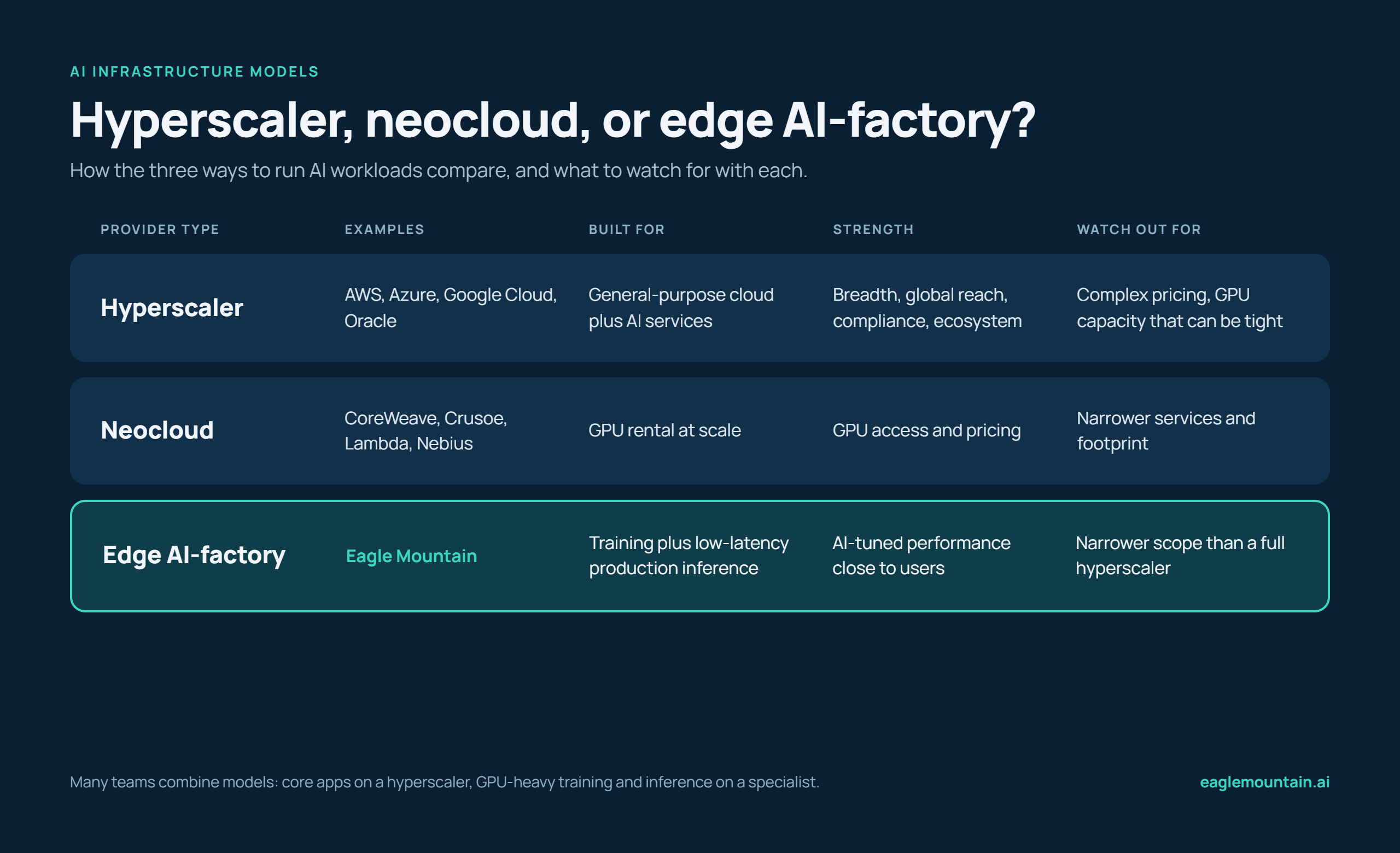
These are not either-or choices. A common pattern keeps business applications and core data on a hyperscaler and runs GPU-heavy training and inference on a specialist platform.
Why Teams Use AI Hyperscalers
- No hardware purchase. You skip the upfront cost of GPUs that may be outdated in a couple of years, and the wait for power, cooling, and procurement.
- Capacity that flexes. Scale up for a training run, then scale back. Inference can follow demand.
- Faster iteration. Spreading training across many GPUs can turn weeks-long cycles into days.
- Less infrastructure work. Managed schedulers, storage, and monitoring mean engineers spend more time on models and less on racks.
Where AI Hyperscalers Get Difficult
- Cost. GPU instances on the big clouds are typically among the priciest ways to rent an accelerator on demand, because the price carries a whole platform.
- Availability. Demand for high-density GPU capacity regularly outruns supply, and lead times can stretch in some regions.
- Lock-in. Proprietary services, data gravity, and platform-specific skills make switching providers harder over time.
- Distance from users. A centralized region is fine for training. For real-time inference, every millisecond of network travel is felt.
- Energy. Large AI facilities draw a lot of power, which raises both cost and sustainability questions.
None of these rule out a hyperscaler. They are the questions to answer before you commit.
What Are AI Hyperscalers Used For?
- Generative AI and LLMs: training, fine-tuning, and serving language and image models.
- Agentic AI: running agents that need fast, dependable responses.
- Healthcare and life sciences: medical imaging, genomics, and drug discovery.
- Financial services: fraud detection and risk modeling, where milliseconds count.
- Robotics and manufacturing: computer vision and predictive maintenance.
- Media and entertainment: rendering, visual effects, and AI-assisted production.
How to Choose the Right Provider for Your AI Workload
Start with the workload, not the brand. These seven questions usually settle it:
- Training or inference? Training tolerates distance. Inference usually doesn't.
- Where are your users and data? The closer compute sits to them, the lower the latency and the easier the data control.
- How much do you need beyond GPUs? If you want a deep catalog of managed services, a hyperscaler fits. If you mostly need fast GPU clusters, a specialist may serve you better.
- Is the capacity actually available? Ask about lead times and what is energized and ready now, not only what is planned.
- How is the cluster monitored? Real-time telemetry catches failing nodes before they stall a job.
- What does pricing look like at your scale? Compare dedicated capacity and flexible terms against on-demand rates for steady workloads.
- What are the security and compliance commitments? Check isolation, encryption, access control, and audit trails, since training data and model weights are valuable IP.
If the answer to most of these is "it depends," a mixed setup is usually the safest start.
Where AI Hyperscaling Is Headed
AI infrastructure is splitting into two jobs. Training stays in large, centralized clusters where power and cooling are cheapest to deliver. Inference, the part customers actually feel, is moving closer to users, because a model that answers in seconds can ruin an experience that should feel instant.
That shift is why bigger is no longer the whole story. Higher power density, liquid cooling, faster interconnects, and smarter scheduling are becoming standard, and the winning designs will be the ones that keep GPUs busy and put results where people are. For a deeper look, read why low-latency AI requires more than a bigger GPU cluster and what edge AI is and how it works.
Where Eagle Mountain Fits
Eagle Mountain is not trying to be a general-purpose hyperscaler with hundreds of services. We are an AI-first platform built for the full AI lifecycle, from large-scale training to inference at the edge, and many of our customers run alongside AWS, Azure, or Google Cloud.
Our stack covers each layer an AI hyperscaler needs, in one place:
- BlinkAI: dedicated GPU compute for training and inference
- Store20: scalable, high-density storage for demanding data pipelines
- LitePulse: low-latency, high-bandwidth fabrics for multi-node clusters
- Swift IQ: managed services that remove operational friction
- TriCore: continuous telemetry and cluster health monitoring
- LumaCore: a platform layer for observability, security, and ML tooling
What sets us apart is where we put it. Our edge AI-factories bring compute close to your data and customers, and we now offer high-density GPU capacity at our fully energized Anaheim data center. New to the terminology? Start with What Is an AI Cloud?.
Ready to put your AI workloads to the test? Explore our GPU cloud, see our edge locations, view pricing, or talk to our team.
Frequently Asked Questions
What is an AI hyperscaler?
An AI hyperscaler is a cloud provider that operates at massive scale and designs its infrastructure around AI: dense GPU clusters, liquid cooling, fast networking, high-throughput storage, and AI-aware software, available on demand.
What is the difference between a hyperscaler and an AI hyperscaler?
"Hyperscaler" describes scale and breadth: a huge, general-purpose cloud. "AI hyperscaler" describes the same kind of provider when judged on AI capability, meaning GPU capacity, networking, and services for training and inference. The term has no formal definition.
Who are the AI hyperscalers?
The names most often cited are AWS, Microsoft Azure, Google Cloud, and Oracle Cloud Infrastructure. GPU-focused neoclouds such as CoreWeave, Crusoe, Lambda, and Nebius compete with them for AI workloads.
What is the difference between an AI hyperscaler and a neocloud?
A hyperscaler offers a broad catalog of services, with AI as one part. A neocloud focuses on GPU infrastructure for AI, usually with simpler pricing and a narrower service list.
Why do AI data centers need liquid cooling?
AI accelerators produce more heat than traditional air cooling can remove efficiently. Direct-to-chip or immersion liquid cooling keeps dense racks within safe temperatures.
Do I need an AI hyperscaler to run AI?
Not always. Calling a hosted model through an API needs no infrastructure of your own. If you train, fine-tune, or host models yourself, you need GPU capacity from a hyperscaler, a neocloud, or an AI cloud provider.
Can I use more than one provider?
Yes. Many teams keep applications and data on a hyperscaler and run GPU-heavy training and inference elsewhere, which also reduces lock-in.
Why does inference location matter?
Training can run far from users. Inference happens every time someone uses your product, so distance adds latency. Running inference at the edge, close to users and data, cuts network travel time.